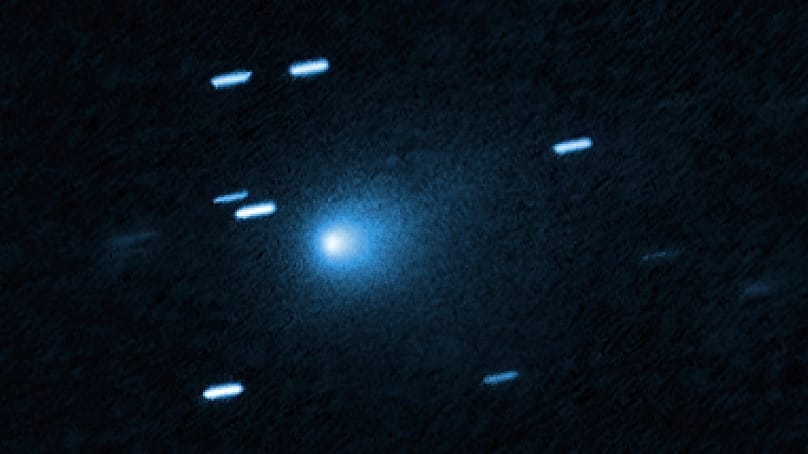
Discovery of 3I/ATLAS
On 1 July 2025, astronomers utilizing the ATLAS (Asteroid Terrestrial-impact Last Alert System) survey telescope in Rio Hurtado, Chile, identified a faint, fast-moving object that had never been observed before. This discovery, officially designated as 3I/ATLAS (C/2025 N1), represents the third confirmed interstellar object ever detected—following ʻOumuamua in 2017 and 2I/Borisov in 2019.
But what is 3I/ATLAS? Where did it come from, and could it be more than just a comet?
Understanding 3I/ATLAS
NASA has officially classified 3I/ATLAS as a comet rather than an asteroid after conducting detailed observations with telescopes that revealed clear signs of activity. Scientists have noted an icy core surrounded by a coma, which is a luminous halo of gas and dust. The outgassing and release of dust indicate that 3I/ATLAS is primarily composed of frozen compounds, aligning with typical comet behavior.
The interstellar object is currently moving through the solar system, offering researchers a rare chance to study material from beyond our cosmic neighborhood. Its name reflects its origin: “3” for being the third interstellar object found, “I” for interstellar, and “ATLAS” for the telescope network that discovered it.
What makes 3I/ATLAS unique is its origin. Its speed and trajectory suggest that it is not gravitationally bound to the Sun, meaning it likely originated from another star system and entered ours by chance.
Speed and Trajectory of 3I/ATLAS
According to astronomers, 3I/ATLAS is traveling at over 200,000 km/h (approximately 61 km per second), and its speed continues to increase as it approaches the Sun. It follows a hyperbolic orbit, indicating that it is moving too quickly to be captured by the Sun’s gravity.
Con Stoitsis, comet and meteor director at the Astronomical Society of Victoria, explained that 3I/ATLAS will pass through the inner solar system between Mars and Earth’s orbit before flying past the Sun. He added that the object will eventually exit the solar system, continuing its journey through space.
NASA states that the closest 3I/ATLAS will get to Earth is about 270 million kilometers.
Could 3I/ATLAS Be More Than a Natural Object?
While most astronomers view 3I/ATLAS as an exciting but natural phenomenon, one prominent scientist, Professor Avi Loeb from Harvard University, has raised intriguing questions about its origins. Through the Galileo Project, which explores potential evidence of extraterrestrial technology, Loeb has questioned whether 3I/ATLAS could be an artificial probe or artefact from another civilization.
In a series of essays published on Medium, Loeb proposed that scientists should consider the possibility that 3I/ATLAS might generate its own light rather than reflect sunlight, a characteristic unlike any known comet. In one essay titled “Does 3I/ATLAS Generate Its Own Light?”, he suggested that if the object is a technological artefact, it could have either benign or potentially harmful intentions.
Loeb warned that if his hypothesis proves correct, it could have significant consequences for humanity. However, NASA has dismissed this perspective, stating that 3I/ATLAS clearly resembles a comet in every way.
Loeb later acknowledged in a blog post that the simplest explanation is that 3I/ATLAS is a comet. He emphasized the importance of maintaining curiosity and seeking evidence rather than assuming answers in advance.
Visibility of 3I/ATLAS
3I/ATLAS is expected to reach its closest approach to the Sun around 30 October, coming within 1.4 au (about 130 million miles), just inside Mars’ orbit. Its size and physical properties are still under investigation, but NASA reports that it should become visible again through ground-based telescopes in early December once it re-emerges from behind the Sun.