Alphabet's Record Revenue and Profit Highlight Continued Dominance
Alphabet Inc., the parent company of Google, has made history by reporting its first-ever quarter with over $100 billion in revenue. This achievement showcases the enduring strength of Google’s internet empire despite ongoing legal challenges and competition.
The announcement comes shortly after a court ruling in the US Justice Department’s landmark monopoly case against Google’s search engine. The case was seen as a minor setback that did not significantly impact the company.
During the July to September period, Alphabet demonstrated impressive performance, recording a profit of nearly $35 billion, or $2.87 per share, a 33% increase from the same time last year. Revenue increased by 16% to $102.3 billion, surpassing analysts' expectations and driving up investor confidence.
Investors responded positively to the third-quarter results, pushing Alphabet’s stock price up more than 6% in extended trading. This set the stage for the shares to reach a new high during regular trading on Thursday.
This growth has contributed to a 30% surge in Alphabet’s shares, creating nearly $770 billion in shareholder wealth since early September. This period coincided with US District Judge Amit Mehta rejecting a Justice Department proposal to break up Google, which had been declared an illegal monopoly.
Google's Monopoly Case and AI Advancements
Judge Mehta's approach to the Google monopoly case reflected his belief that rapid advancements in artificial intelligence have led to the emergence of conversational "answer engines" like ChatGPT and Perplexity, providing consumers with more options.
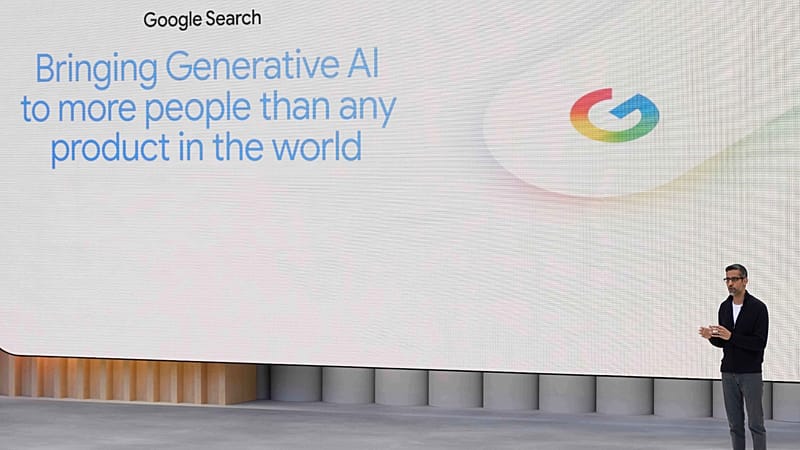
OpenAI, the creator of ChatGPT, and Perplexity have introduced AI-powered web browsers that compete with Google’s Chrome browser. However, Google has been integrating more AI features into its search engine, Chrome, and other products to protect its market position and explore new technological frontiers.
In a recent development, Alphabet CEO Sundar Pichai revealed that Google's AI-powered Gemini app now has 650 million monthly users. Pichai described this as a sign of Google's expansionary moment and emphasized the impact of AI on business results.
Funding AI Ambitions
Like other major tech companies, Google has been investing heavily in AI, raising concerns about a potential bubble. Alphabet now expects to allocate between $91 billion and $93 billion for capital expenditures this year, an increase from the previous quarter's $85 billion.
Most of this funding is directed towards building large data centers to support AI initiatives. Alphabet's CFO, Anat Ashkenazi, mentioned that capital expenditures are expected to rise next year, with more details to be provided in early 2026.
Analyst Thomas Monteiro noted that Alphabet is not ready to relinquish its lead in the AI-driven market. The company continues to benefit from a lucrative ad network built over 25 years, with Google's ad sales reaching $74.2 billion in the third quarter, a 13% increase from the previous year.
Growth in Google Cloud and Ongoing Legal Challenges
The AI boom has also benefited Google's Cloud division, which oversees data centers for other companies. This segment has become the fastest-growing part of Alphabet, with Google Cloud posting $15.2 billion in revenue, a 34% increase from the previous year.
While Google has managed to withstand legal attacks on its search engine, it still faces another potential challenge from the Justice Department regarding its ad technology. After labeling parts of Google's ad technology as an illegal monopoly earlier this year, US District Judge Leonie Brinkema is considering ways to limit Google's influence in the future.
The Justice Department is seeking a court order to force Google to sell parts of its ad network, but a ruling on this matter is not expected until early next year.