A Cosmic Creepy Crawler Revealed by the James Webb Space Telescope
Astronomers have unveiled a stunning image of a cosmic creature that looks like a spider, just in time for the spooky season. This image showcases the Red Spider Nebula, a mysterious celestial object that has never been seen in such detail before.
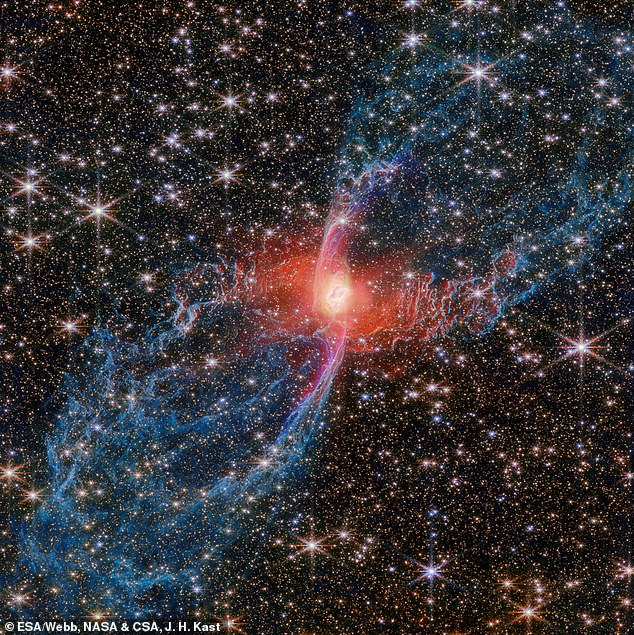
The James Webb Space Telescope (JWST) captured this remarkable image using its Near-Infrared Camera (NIRCam). The picture reveals the nebula against a backdrop of thousands of stars, with glowing structures that resemble the webs of ionized gas surrounding it. At the center of the nebula, the central star is clearly visible, shining brighter than its surroundings.
Dr Mikako Matsuura, from Cardiff University's School of Physics and Astronomy, described the Red Spider Nebula as one of the most eerie and ghostly nebulas in the universe. She noted that among the so-called "spider nebulae," the Red Spider stands out for its chilling resemblance to a cosmic creature. Its twisted filaments stretch like the legs of a celestial arachnid, making it a fascinating subject for astronomers.
Planetary nebulae like the Red Spider form when ordinary stars, similar to our Sun, reach the end of their lives. After expanding into cool red giants, these stars shed their outer layers and cast them into space, exposing their extremely hot cores. Ultraviolet light from the central star then ionizes the material, causing it to glow.
The new view from the JWST reveals the full extent of the nebula's outstretched lobes, which form the "legs" of the spider. These lobes stretch across the entire field of view, appearing as closed, bubble-like structures that each extend about three light-years. Over thousands of years, outflowing gas from the center of the nebula has inflated these massive bubbles.
Although only a single star is visible in the Red Spider's heart, scientists believe there may be a hidden companion star nearby. Having a stellar friend could explain the nebula's shape, including its narrow waist and wide outflows. Dr Matsuura explained that the legs are hairy and shine with molecular hydrogen emission, which have escaped from a torus-shaped ring.
It is still unclear why the outflows appear "hairy." One possibility is that the outflow from the primary star was not continuous, perhaps because mass transfer from the companion star affected the timing of the outflow. Another possibility is that the outflow interacted with the surrounding interstellar medium. Since the interstellar gas is not uniform, such interactions could cause the outflow to fragment, creating the hair-like structures along the legs.
Gas is also actively jetting out from the nebula's center, forming an elongated purple "S" shape centered on the heart of the nebula. Previous optical-wavelength images of the same nebula show the star appearing faint and blue. However, the near-infrared technology used to capture this new photo brings to light wavelengths that are usually beyond the visible spectrum, providing the spectacular image.
The Red Spider won't be around forever, as the planetary nebula phase of a star's life only lasts a few tens of thousands of years. The team's analysis is published in The Astrophysical Journal.
Other Cosmic Mysteries
Could these stunning images be a once-in-a-lifetime glimpse of planet birth, exposing awe-inspiring spirals of dust and gas 440 light-years away?
Could NASA's stunning 'spiderweb' find on Mars unravel the ultimate mystery of alien life lurking beneath its surface?
Are these 'Red Monster' galaxies a new cosmic conundrum or mere optical illusions masking early universe secrets uncovered by JWST?
The truth at last? Awe-inspiring images reveal 3I/ATLAS's vast tail and coma, silencing wild alien theories once and for all!
Will the dim light of K2-18b's red dwarf star nurture alien creatures with eerie, oversized eyes or gigantic wings?