US Interest Rate Cut and Political Tensions
The recent quarter-of-a-percentage point reduction in US interest rates, bringing it to a 3.75 per cent to 4 per cent range, was widely expected by financial analysts and market participants.
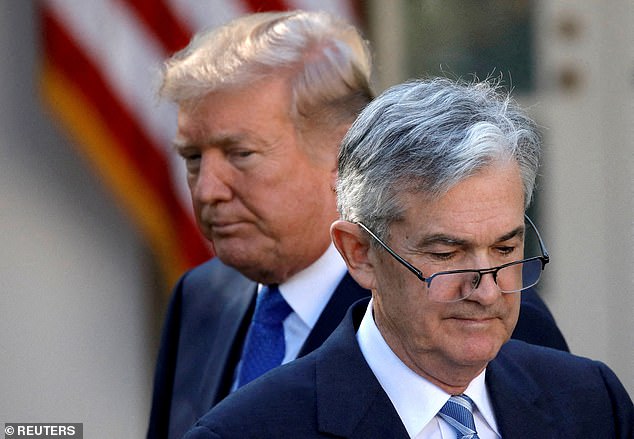
This cautious approach to rate cuts has created significant tension between Federal Reserve Chair Jay Powell and former President Donald Trump. Trump has been vocal in his criticism of Powell, even calling him a “knucklehead” and a “stiff” for maintaining high interest rates for an extended period.
The pressure on the Federal Reserve intensified when US Treasury Secretary Scott Bessent called for at least a 1.5 percentage point cut, while Trump demanded double that amount. This has only strengthened the Fed’s resolve to protect its independence from political interference.
The prolonged five-week government shutdown has left economic decision-makers without access to crucial data, making it challenging to make informed policy decisions.
Job Losses and the Role of AI
White-collar jobs are disappearing rapidly, with major companies like Amazon, UPS, and Target announcing significant layoffs this week. Much of the blame is being attributed to the rise of artificial intelligence (AI), which is reshaping industries and reducing the need for human labor.
Despite these challenges, a rate reduction was seen as inevitable. However, the situation in the UK looks different. The Bank of England's upcoming meeting on November 6 is considered unlikely to result in a rate cut, given the upcoming Budget and the uncertainty surrounding the Chancellor Rachel Reeves' plans.
However, with inflation remaining steady at 3.8 per cent and the job market cooling, the chances of a rate cut have increased. Economists at Goldman Sachs are encouraging the Monetary Policy Committee to lower rates, which could boost consumer and business confidence that has been severely affected by the threat of heavy tax increases.
Emma Walmsley’s Final Chapter at GSK
Emma Walmsley, CEO of GSK, is ending her tenure on a high note. Her final results presentation highlighted her achievements in navigating challenges posed by activist investor Elliott, spinning off the consumer healthcare arm Haleon, and advancing oncology research.
The strong performance of Jemperli, an immunology medicine for endometrial cancer, underscores GSK’s progress. It is not just investors and employees who benefit from GSK’s success; the UK’s life sciences sector plays a vital role in shaping a better future.
Walmsley emphasized the importance of maintaining the UK’s tax competitiveness during her third-quarter results briefing. She pointed out that pharmaceutical companies benefit from R&D credits and the Patent Box scheme, which reduces corporation tax.
GSK now expects annual sales and profits to surpass previous targets, with earnings per share growth projected at 10 per cent to 12 per cent, up from a previous range of 6 per cent to 8 per cent.
Sales of GSK’s groundbreaking HIV treatments rose 12 per cent to £1.9 billion. Vaccine revenues, however, have declined in the US due to the anti-vax views of Health Secretary Robert F Kennedy Jr. Sales of Shingrix, a shingles vaccine, have struggled. Despite this, vaccines are performing well in Europe, and GSK is hopeful that early trials showing Shingrix’s effectiveness in treating dementia will be confirmed in larger studies.
GSK shares have lagged behind UK rival AstraZeneca but recently saw a 6.6 per cent increase, outperforming its competitor and achieving a 30 per cent gain this year.
John Malone’s Exit from Liberty Media
John Malone, known as the “Cable Cowboy,” has been divesting assets, including halving his stake in ITV as he simplifies his empire. Now, the 84-year-old media and Formula One magnate is stepping down as chairman of Liberty Media and Liberty Global.
Malone had a long-standing rivalry with Rupert Murdoch in the early 2000s, resulting in an asset swap and Murdoch having to buy out Liberty’s stake in his empire.
His departure could unlock his 50 per cent ownership of Virgin Media and a remaining 5 per cent stake in ITV. Watch this space!