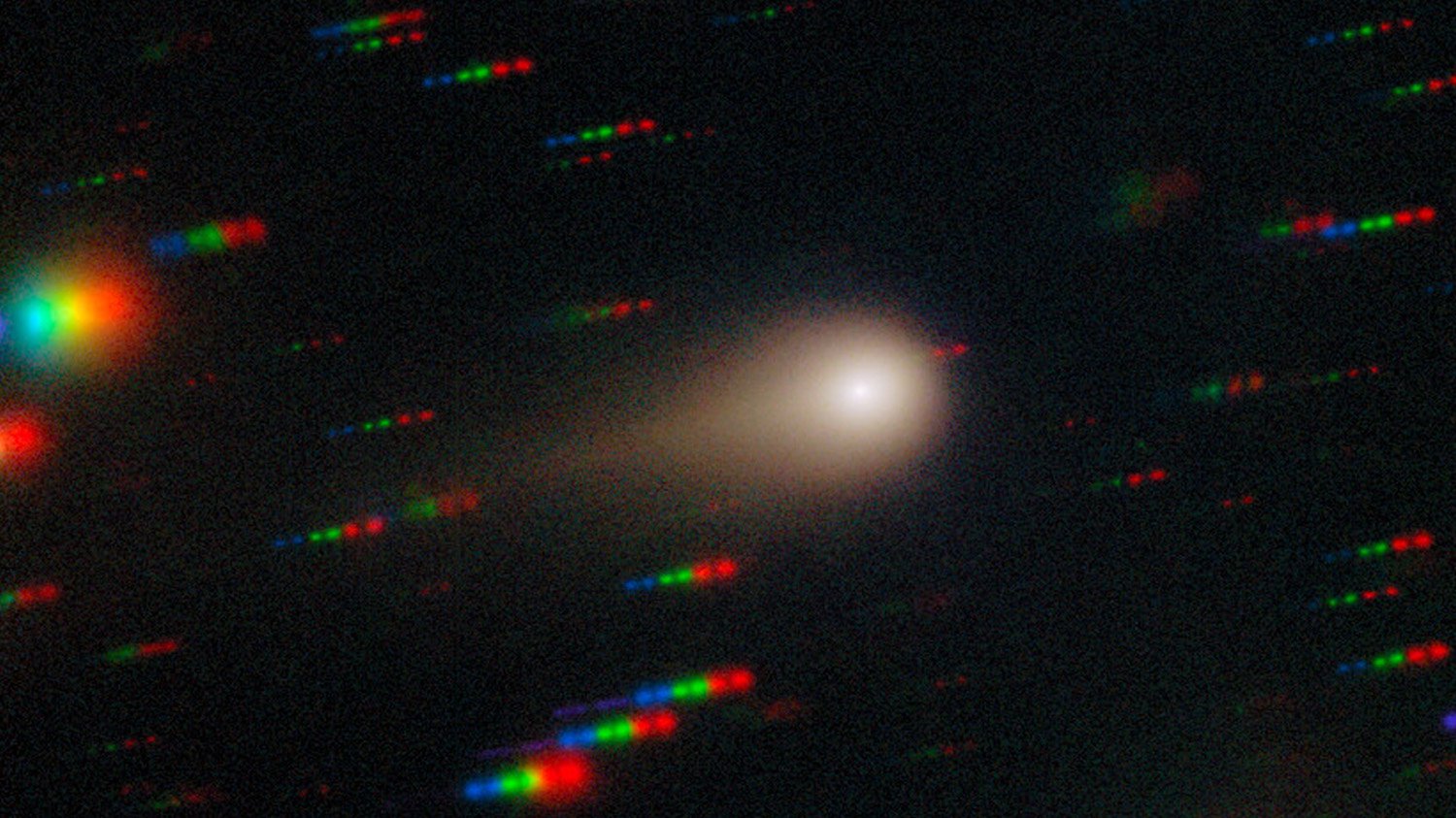
The upcoming days will bring clarity on whether Comet 3I/ATLAS is truly an intergalactic Trojan Horse, potentially releasing small probes while hiding behind the sun. Although this theory is highly improbable, it has been proposed by a controversial astrophysicist. Nevertheless, it has drawn attention to a fascinating object that has traveled to our solar system from another star.
What exactly is 3I/ATLAS and how large is it?
Dr Mark Norris, from Lancashire University, stated that there is no evidence suggesting the interstellar comet has a technological origin. He believes it's unfortunate that the idea has gained so much attention, as the comet itself is intriguing enough.
In a recent presentation about the first 100 days since its discovery in July, he titled it: ‘Spoiler: It’s not Aliens’. But if it's not aliens, then what is it?
Dr Norris explained to the audience: “It’s something that has drifted through space, likely for longer than our solar system has existed.” He mentioned that if it behaves differently from comets we usually observe, this should be expected due to its distinct chemical composition. This composition would have formed when our galaxy was younger, with fewer supernovas exploding and spreading elements.
Dr Loeb pointed out the comet's nickel emissions without iron, which resemble those found in industrially produced alloys. He also highlighted its 'anti-tail' where the dust trail points towards the Sun instead of away from it, then switched, which he suggested could indicate 'braking thrust'.
However, Dr Norris emphasized: “There is nothing about this object that would concern anyone who understands comets or the solar system.”
To recap, 3I/ATLAS is only the third space rock ever identified as coming from outside our solar system. After being identified around four months ago, it has traveled through our neighborhood in a 'hyperbolic orbit', meaning it is moving fast enough to escape the sun's gravity and will return to outer space for potentially billions more years.
Probably not: even Dr Loeb has said it's unlikely to have an unnatural origin, but he thinks it's important to consider the possibility of a highly destructive 'black swan' event.
Dr Norris acknowledged that if it were dangerous, it could be 'very bad'. However, he added: “The fact is, there are many good planetary scientists studying comets who are looking at this and working together, and they're not concerned by it. So why would you do anything? If after November 2, when we start tracking it again, it's doing something unusual, then fine. But there's no reason to be concerned now.”
So, we should find out more in four days…